


Why Retention Is Cheaper Than Replacement - The business case for investing in employees in Mauritius
Why retention is cheaper than replacement in Mauritius. A practical business case showing the real cost of turnover, hiring delays, and productivity loss.
Tomek Joseph
2/9/20263 min read
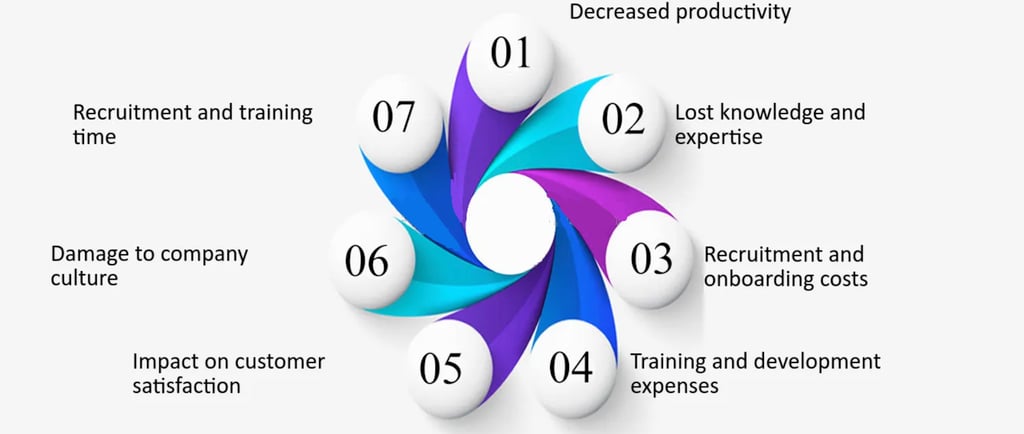
Employee turnover is rarely a standalone HR issue. In Mauritius’ small and interconnected labour market, each avoidable resignation triggers a multi-month replacement cycle, measurable productivity loss, increased hiring friction, and reputational impact.
Replacing an employee typically costs 20–40% of annual base salary, excluding disruption and institutional knowledge loss. Organisations that invest earlier in sustainable work design, managerial capability, and retention reduce structural risk, stabilise delivery, and protect long-term performance. Retention is not a wellbeing initiative — it is a cost-control and risk-management decision.
1.What Really Happens When One Employee Leaves
Most organisations underestimate what actually unfolds after a resignation.
The focus tends to be narrow:
recruitment
interviews
onboarding
In reality, the cost begins earlier and ends later.
When an employee leaves, the organisation enters a replacement cycle that includes:
instability before departure
a vacant or partially covered role
recruitment and hiring
onboarding and training
gradual ramp-up to full productivity
This cycle typically spans several months. In practice, full productivity replacement often takes 6–9 months, sometimes longer depending on role complexity.
During this period, organisations absorb:
reduced output
diverted managerial attention
project delays
increased pressure on remaining team members
Replacement is therefore not a single event. It is a sustained productivity gap.
2.Why Retention Is a Cost-Control Strategy, Not a “People Initiative”
Turnover costs are often underestimated because they are distributed rather than visible.
Well-established benchmarks consistently estimate that replacing an employee costs approximately 20–40% of annual base pay, depending on role complexity.
For example:
An employee earning MUR 45,000 per month has an annual base of MUR 540,000
Replacement cost typically ranges from ~MUR 108,000 to ~MUR 216,000
This excludes client disruption, lost institutional knowledge, and morale impact
Critically, much of this cost is incurred before the resignation:
disengagement
presenteeism
reduced discretionary effort
slowed execution
Stress and burnout accelerate this process. When workload pressure remains unresolved:
performance declines before departure
exits become more frequent
replacement cycles overlap
Retention, therefore, is not about perks or persuasion. It is about preventing avoidable financial leakage.
3.Why Retention Carries Higher Strategic Weight in Mauritius
In larger labour markets, turnover can be absorbed through scale. In smaller markets, it becomes structurally visible. Mauritius operates with:
a limited and specialised talent pool
overlapping professional and personal networks
rapid informal information flow
As a result, employee movement is rarely isolated This has three strategic implications.
1️⃣.Replacement timelines extend beyond hiring
In small markets, replacement is not purely transactional. Vacancies remain open longer. Notice periods compound delays. Specialised roles face constrained candidate availability.
This extends the replacement cycle and increases exposure to:
sustained productivity gaps
leadership bandwidth erosion
delivery risk
A single resignation frequently translates into a multi-month operational constraint.
2️⃣.Employer reputation directly affects hiring cost
Employer reputation functions as a market signal. Departing employees do not exit anonymously. Their experiences are shared within professional and social networks. Over time, this influences:
candidate willingness to apply
salary premiums required to attract talent
length of recruitment cycles
Organisations with higher turnover often compensate through:
higher recruitment spend
longer vacancy periods
increased onboarding risk
This is not a branding issue. It is a market-efficiency issue.
3️⃣.Retention is a form of risk management
From a leadership perspective, retention should be understood as structural risk reduction.
Lower turnover stabilises:
delivery continuity
institutional knowledge
leadership credibility
execution predictability
Organisations that invest early in:
manager capability
sustainable workload design
decision clarity
psychological safety
reduce not only attrition, but the compounding costs of replacement. In this context, retention is not an HR outcome. It is a strategic control mechanism.
Conclusion
Investing in employees is not generosity. It is cost control. Every avoidable resignation prevents:
recruitment expenditure
months of reduced productivity
reputational drag in a small labour market
Retention is not achieved through programmes. It is the compound result of how work is designed, managed, and led — every day. In Mauritius, that compound effect materialises faster than most organisations expect.
Related articles
If this topic resonates, you may also find these relevant:
– The opposite of toxic isn’t nice — it’s sustainable work
👉 https://www.tomekjoseph.com/the-opposite-of-toxic-isnt-nice-its-sustainable-work
– Stress is the hidden cost behind disengagement at work
👉 https://www.tomekjoseph.com/stress-is-the-hidden-cost-behind-disengagement-at-work
– What really stresses employees in Mauritius — it’s not what most leaders think
👉 https://www.tomekjoseph.com/what-really-stresses-employees-in-mauritius-its-not-what-most-leaders-think